
Use case
Load & renewable forecasting
Forecasts that keep the lights on and costs down
Ensemble models with weather and DER signals reducing MAPE 14% and saving $4.2M in fuel and imbalance.


Yesterday's forecast models cannot keep pace with today's grid volatility.
The Challenge
An investor-owned utility in an RTO footprint saw forecast error growing as distributed solar and EV charging shifted load shapes. Manual analyst tweaks did not scale across zones; day-ahead MAPE was drifting upward, and imbalance penalties and unnecessary fuel commitments were costing $8M+ annually. Weather volatility compounded the problem—models calibrated on historical norms underperformed during extreme heat, cold, and cloud events.
The Innovoco Solution
We built ensemble forecasting models combining weather ensembles, behind-the-meter DER signals, and calendar features—published to market operations APIs with confidence bands so dispatchers and traders can act on uncertainty, not just point estimates.

Phase 1 — Data integration and baseline
Ingested SCADA, AMI, weather API, and DER registration data. Established MAPE baselines by zone and horizon (day-ahead, 4-hour, 1-hour). Identified where legacy models underperformed most—typically high-DER feeders and weather-sensitive zones.

Phase 2 — Model deployment and operations handoff
Deployed ensemble models with automated retraining on rolling windows. Confidence bands publish alongside point forecasts. Dispatchers receive zone-level dashboards with drill-down to feeder anomalies. Full rollout completed in six weeks after parallel-run validation.
Key implementations
Weather ensemble integration
Blends multiple numerical weather prediction sources with location-specific bias correction, reducing forecast error during extreme and transitional weather events.
Behind-the-meter DER signals
Ingests inverter telemetry and smart meter net-load to disaggregate rooftop solar and EV charging from gross load, improving net-load accuracy on high-DER feeders.
Confidence bands and scenario APIs
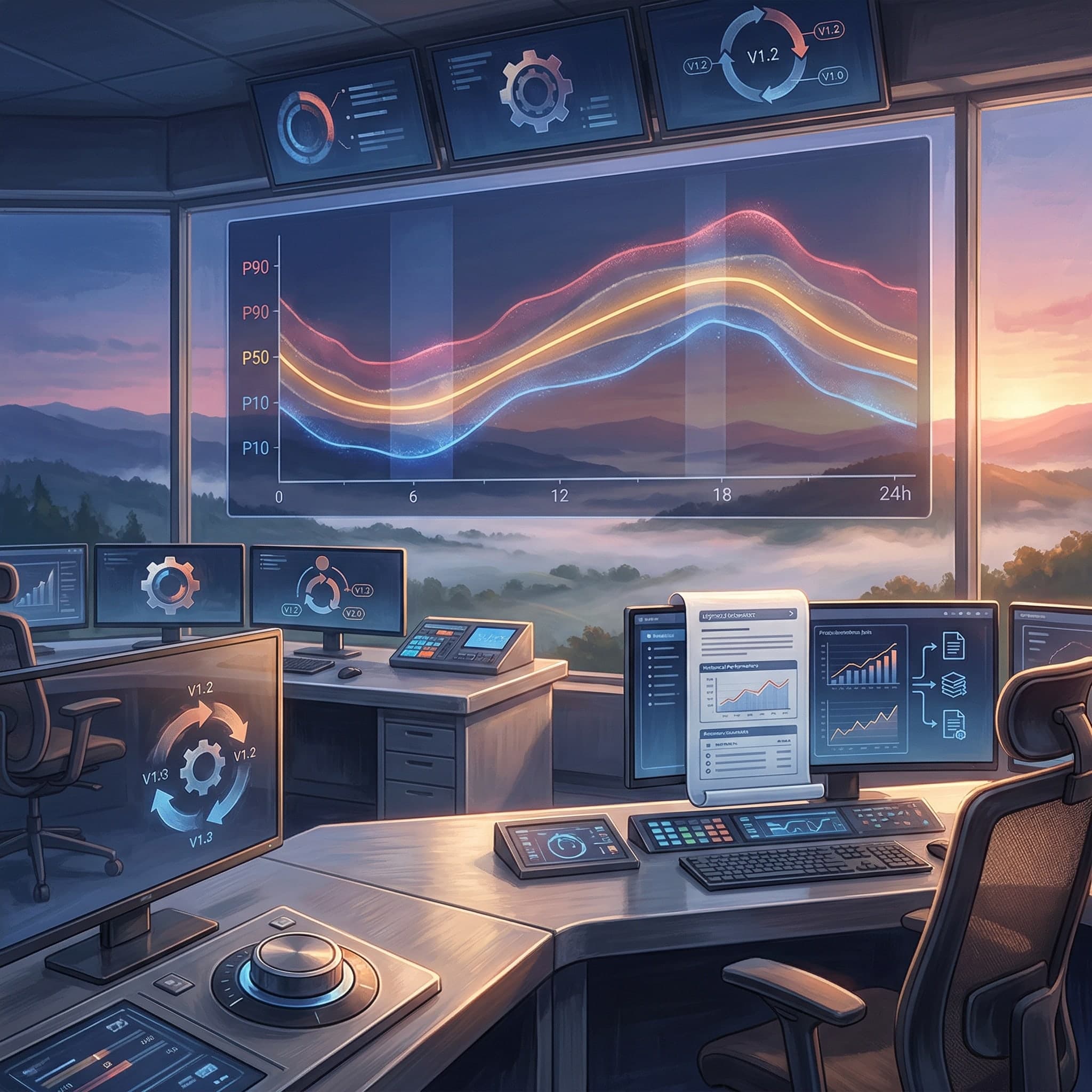
Probabilistic forecasts with P10/P50/P90 bands published to dispatch and trading systems, enabling risk-aware unit commitment and hedging.
Automated retraining
Rolling-window retraining triggered by accuracy drift or seasonal transitions, with model versioning and rollback. No manual intervention for routine updates.
Regulatory-ready documentation
Model assumptions, data lineage, and performance logs exportable for rate case filings and reliability reporting.
Technical Innovation
A unified data layer aligns grid telemetry, smart meter readings, weather, and distributed energy data to common timestamps—solving the timing and missing-data problems that degrade forecasts in real operations. Model weightings adapt automatically by zone and weather pattern.


Impact
- 14% MAPE reduction across all forecast horizons, with largest gains on high-DER zones.
- $4.2M annual savings from reduced fuel burn, imbalance penalties, and reserve procurement.
- Full production rollout in six weeks after parallel-run validation.
- Confidence bands adopted by trading desk for day-ahead and real-time hedging decisions.
Dispatchers and traders now operate with forecasts that reflect today's grid—not yesterday's—and uncertainty bands that turn volatility from a cost into a manageable risk.

Explore this outcome on your stack
We map scope, guardrails, and rollout to your data boundaries and teams—practical next steps, not a generic slide deck.
60 min · Free · No obligation
More case studies
Explore adjacent patterns from the same production playbook.